
Find Seattle Residents by Source
The route depends on whether the starting point is a name, current address, old address, phone number, or date. King County property tools connect a street address to a parcel and taxpayer. The Recorder connects parties to deeds and other recorded instruments. Washington Courts can place a name in a dated case index. Seattle Public Library and Seattle City Archives preserve earlier directory evidence.
No public roll lists every Seattle resident. Keep the exact role shown. “Taxpayer,” “grantee,” “registered agent,” and “case party” do not mean resident. A sound residents directory search records the label, date, jurisdiction, and source before comparing another record.
- Copy the name or address exactly as the source shows it.
- Use the King County Assessor to find the parcel and taxpayer.
- Check Landmark by name, parcel, document type, and date.
- Compare a court, archive, or directory record from the same period.
- Request the file when the online result is only an index.
Seattle Residents Records Custodians
Seattle records are split among city, county, and state keepers. The Recorder holds recorded land instruments; the Assessor maintains present property facts; Elections handles a resident's own voter lookup; and each court retains its official case file. Online search is only one channel. The Recorder offers in-person and mail copy service, while older land records are at King County Archives. The Washington Public Records Act, RCW 42.56, provides a request route for agency records not already published, subject to exemptions.
Seattle Property Directory Fields
King County eReal Property is the direct official start for a known Seattle address. It accepts an address or parcel number and offers a condo or apartment-complex option. A detail record may show owner, legal description, zoning, lot size, present use, utilities, building count, area, age, value, maps, and tax links. It is a place record, not proof of each occupant.
| Search control | Resident-research use |
|---|---|
| Street address | Find the current parcel tied to the site. |
| Parcel number | Carry a stable key into maps and deed research. |
| Condo or complex | Separate a development from one street entry. |
| Owner and mailing fields | Keep the stated role distinct from occupancy. |
The eReal Property search shows these paths.
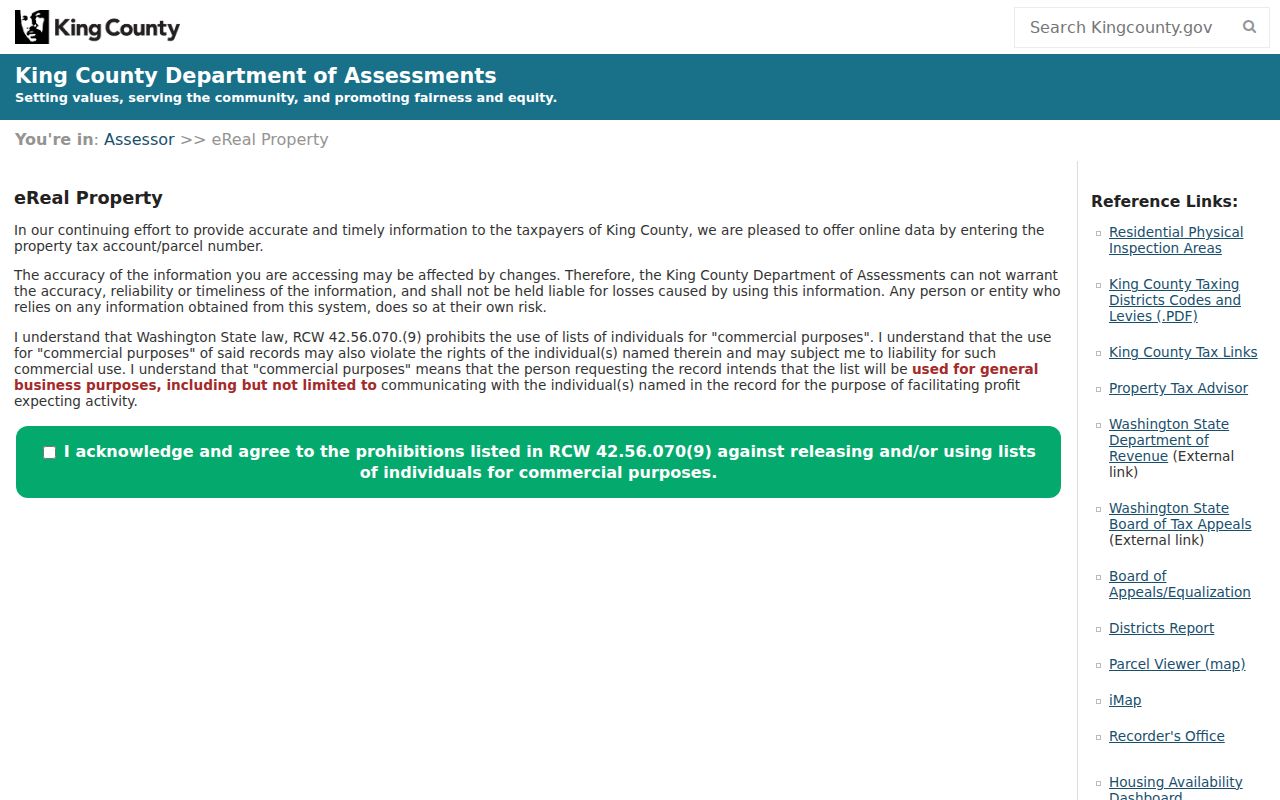
The interface shows why exact address formatting and parcel confirmation should precede a name claim.
Map Seattle Residents to Parcels
Parcel Viewer and iMap add geography that a name list cannot. Parcel Viewer searches by address, parcel, condo name, or intersection. Selection, buffer, measurement, layers, and export tools reveal nearby parcel IDs and the jurisdiction around a point. Property and district reports may show use, taxpayer, value, lot area, levy code, and unit counts. Lines are approximate, so the map does not replace a survey or recorded legal description.
Open the King County Parcel Viewer to test the parcel context.
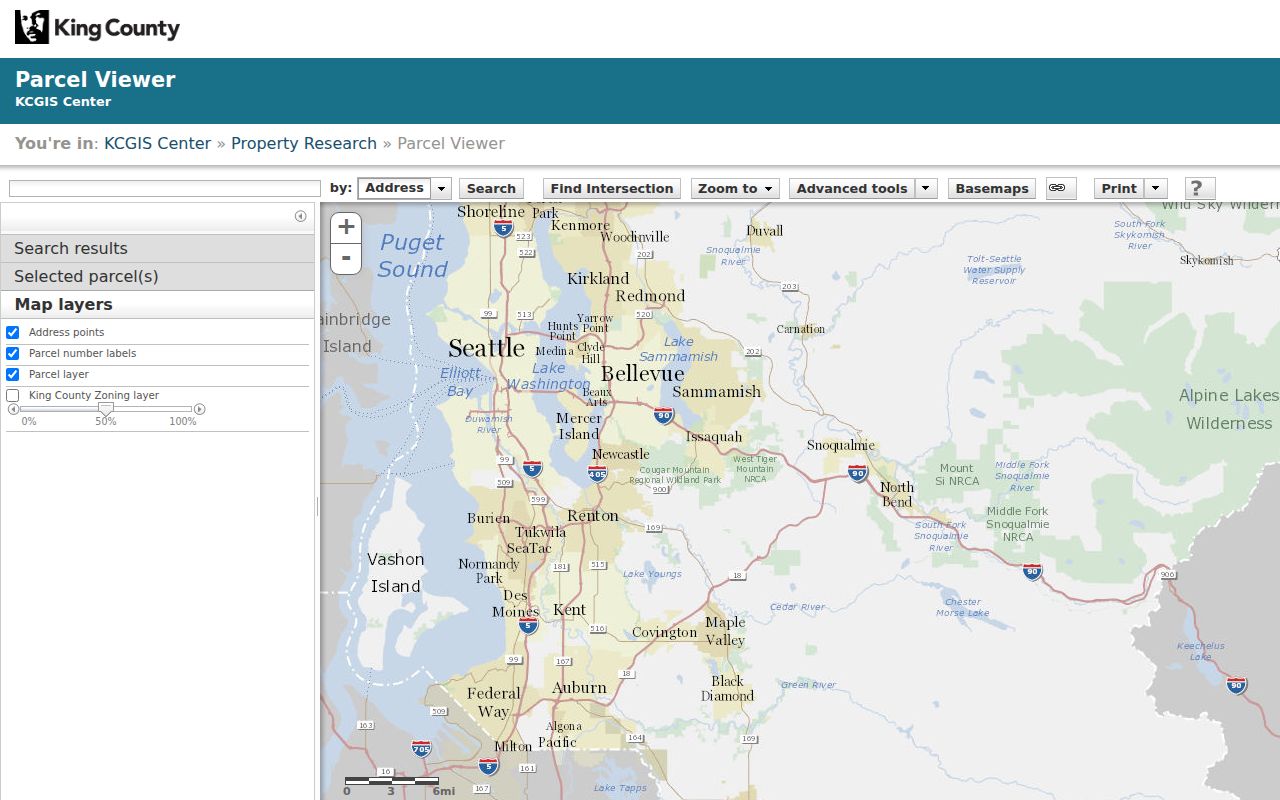
The map ties an address to a parcel while keeping taxpayer and occupant roles apart.
Seattle Recorder Name Trails
Landmark indexes most King County recorded material from August 1, 1991 forward. Name Search supports grantor, grantee, or both roles, with Starts With, Contains, and Equals matching. Other paths use document type, book and page, parcel ID, date, legal description, Torrens, or plat reservation data. It has no direct street field, so move from address to parcel in the Assessor, then to parcel or party in Landmark.
The Landmark index displays those paths.
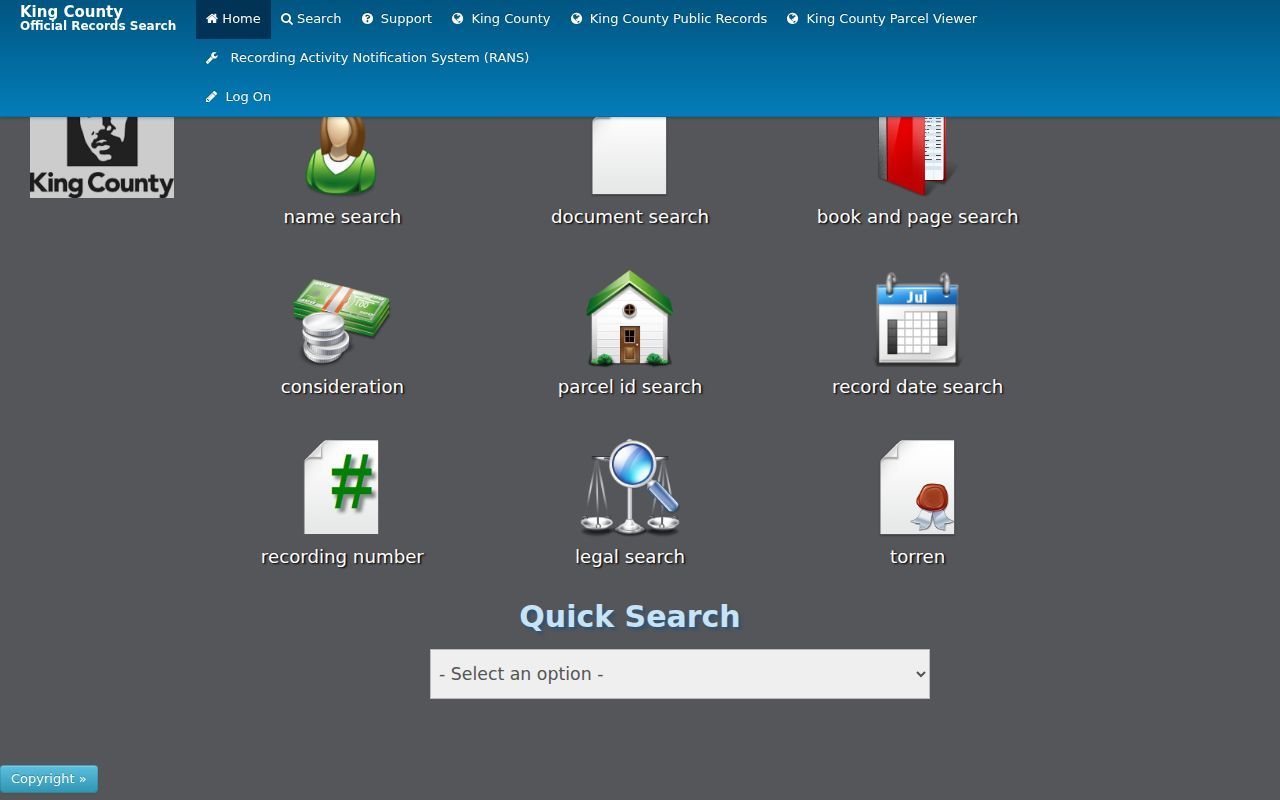
An index hit is a lead. The image or certified copy from the Recorder supplies full context. Pre-1991 books and microfilm are available through King County Archives.
Current Seattle Residents Directory Sources
Current official sources describe narrow roles, not whole households. Compare only dates and identifiers that align.
| Seattle source | Role shown | Keeper | Access |
|---|---|---|---|
| eReal Property | Owner or taxpayer | Assessor | Web, phone, office |
| Landmark | Recorded-document party | Recorder | Web, mail, office |
| My Voter Information | Own registration | Elections | Protected self-lookup |
| Washington Courts | Case-party reference | Court of record | Index, clerk copy |
| CCFS | Business filing role | Secretary of State | Public search |
Commercial people-finders may merge stale or unrelated data. Official sources are narrower, but they state the keeper, role, and route to the original.
Seattle Court Directory Limits
Washington Courts Name and Case Search accepts names, case or business numbers, court, case type, and year. Its daily index is reference information. The court of record supplies the official docket and documents. A docket is the dated list of filings and events. Odyssey offers public search modes, while sealed, juvenile, and confidential material stays closed.
For older or non-online Seattle Municipal Court material, request a copy from the clerk by case name, number, or citation. King County Superior Court Clerk handles its copies and administrative records. A party listing, allegation, or filing is not a final finding. Match court, date, case number, and disposition before linking it to a Seattle residents directory entry.
Names need their own check. Search a middle initial, former surname, spelling variant, and narrow year range before joining two results. Then compare a public address, organization, parcel role, or dated news item from an independent source. If the dates or identifiers conflict, keep both records separate. The correct output is sometimes “possible match,” not a forced identity. This is especially important with common surnames and with case indexes that display only a small part of the official file.
Seattle Voter Lookup Is Personal
My Voter Information is a self-lookup, not a public directory. It matches three of four fields: first name, last name, birth date, and house number. It returns that resident's registration and ballot facts. VoteWA provides the state route. RCW 29A.08.720 bars use of public voter lists for advertising or solicitation.
The King County voter form makes the boundary clear.
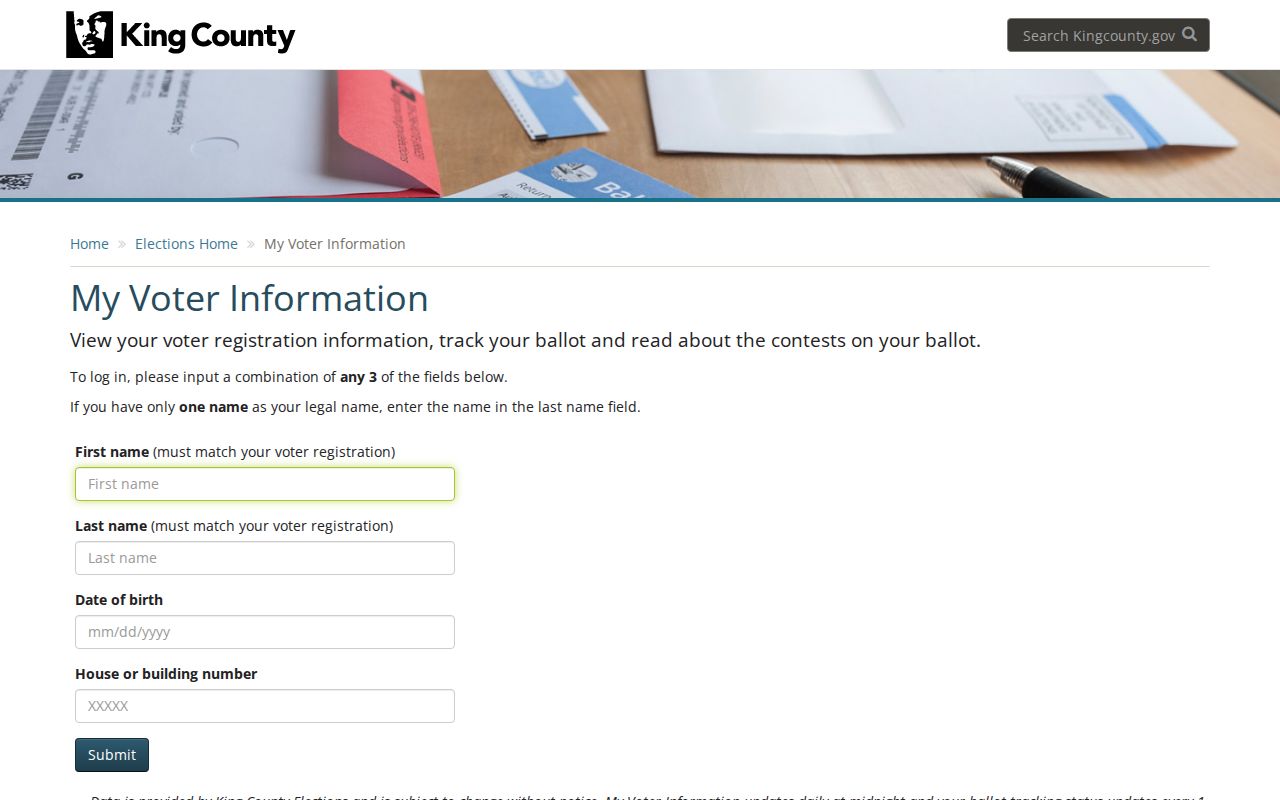
Its limited match protects self-service access without creating a block contact list.
Request Seattle Resident Records
For a city record missing from a portal, use the Seattle Public Records Request Center. Name the department, topic, date span, and exact record. The request itself may be public, apart from secure payment data. King County accepts requests through its portal or email. Both generally send an initial response within five business days, which may provide records, estimate time, seek clarification, or cite a denial.
Inspection is free. Copies, transmission, storage, and customized work can cost money; King County may request a deposit up to ten percent. Narrow language works best. Ask for a defined record series and date range, not “all records about residents.” The Public Records Act does not override vital-record, court, voter, juvenile, or protected-address rules.
Send the request to the agency that created or keeps the record. Seattle's center routes city material by department and topic. King County's form asks for departments or locations, a date span, delivery choice, and contact details; email requests may also go to PRA.Requests@kingcounty.gov. The King County response can arrive in installments when a set is large. It may also include a fee estimate or an exemption log that identifies withheld material. Save the request number and each agency message. Those details document what was searched and prevent an unanswered portal query from being mistaken for proof that no record exists.
Historical Seattle Residents Directory Runs
Seattle Public Library offers searchable directory selections from 1867 through 1940. Its 1928 House and Street Directory works in reverse by address. Seattle City Archives holds a broader 1890 through 1990 run plus tax, docket, annexation, and street-history files. The Seattle Room's print and microfilm holdings, staff help, and appointments cover searches that the web cannot finish.
An old entry may show a name, spouse, occupation, employer, and address, but abbreviations and publication date matter. The full shelf is described in the Seattle Directory Book. Here, one dated volume is evidence of a listed association, never proof of current residence.
Decode Seattle Directory Terms
Four terms prevent common mistakes.
- Parcel
- A mapped unit of land with a county identifier.
- Situs address
- The property's physical address, which may differ from a mailing address.
- Index
- A finding aid that points to a record but may omit its full text.
- Criss-cross directory
- A book arranged by street and number rather than only by surname.
A parcel may contain many units, and a taxpayer can receive mail outside Seattle. Preserve each label before combining sources.
Seattle Streets Shifted Over Time
Seattle incorporated in 1869 and expanded by annexation. Ballard, Columbia, South Park, and West Seattle joined in 1907; Georgetown followed in 1910. An older address may therefore be filed under a predecessor city. City Archives keeps annexation maps, ordinance indexes, and research-room copies that bridge those jurisdictions.
The 1961 directional street-system change creates another trap. Save the old wording and consult City Street Designation Maps. North-end addresses and West Seattle prefixes can differ across years even when the site is the same. A blank current search is not proof that a record never existed.
Place labels also need a source. Seattle reports 53 Community Reporting Areas, but the city calls them census-based approximations. A common neighborhood name, postal city, ZIP, council district, and parcel jurisdiction may describe different boundaries. For Ballard, West Seattle, Georgetown, or another annexed community, note whether the name comes from a current city map, an old directory, or local usage. That one line can explain why two accurate records seem to disagree.
Vital Paths for Seattle Residents
Washington Department of Health holds statewide births from 1907 and marriages and divorces from 1968. Informational birth and death copies are broadly available; certified copies require a qualified applicant, identification, and proof. Marriage and divorce copies may be ordered by anyone. Research lists a general $25 charge per certificate, copy, or search, but current fees should be checked before ordering.
Earlier material may be held by a county office, court clerk, Washington State Archives, King County Archives, or Digital Archives. A searchable historic index narrows a date and name but is not the certificate. Sealed records and eligibility rules still apply.
The order channel depends on the event and year. The DOH birth form asks for the subject's name, birth date and place, parents' names, requester details, relationship proof, identification, and a signed declaration. Its mail route goes to the department in Olympia. The marriage and divorce form asks for both parties, prior surnames, approximate date, and the county that issued or filed the record. A marriage before 1968 may require the county auditor, while a divorce from that period may require the superior court clerk. Washington Digital Archives can supply a historic index or image for some collections, and archive staff can help when the web search lacks a usable result.
Protect Seattle Resident Addresses
Washington's Address Confidentiality Program, under chapter 40.24 RCW and chapter 434-840 WAC, gives eligible survivors and protected groups a substitute address. Participation is confidential, and existing public records are not erased at once. If a mismatch may involve protected data, stop. Do not seek or publish the real address.
Lawful use. Use Seattle records for genealogy, estate work, civic review, family reconnection, or scam checks, never to stalk, harass, threaten, or expose a protected person.
Correction routes vary. The Recorder accepts image-removal requests for exposed identifiers. Courts and agencies follow their redaction rules. Elections corrects voter data, while DOH handles vital amendments and access.
Seattle Archives Expand Access
April 2026 Library Board material described curators who began in 2025, a digitization program, 985 added local-history items, and a Seattle Public Library History Collection. Separate 2025 levy reporting counted over 1,700 local-history additions and more than 530 research appointments. Those are dated service figures, not permanent totals.
Newly available business directories, images, newspapers, and oral histories can corroborate a name or place missing from a portal. Record the capture date and collection title. A Seattle residents directory conclusion is strongest when a digital result still points to the library or archive holding it.
Research help is an access channel, not a last resort. The Seattle Room holds noncirculating maps, yearbooks, newspapers, oral histories, photos, and directories. Its genealogy collection sits on another floor, and appointments support unique material. City Archives staff can guide a search across municipal dockets, tax lists, annexation files, and the Denny Park Cemetery Removal and Reburial Register. King County Archives adds historic tax rolls, property cards, early deeds, and local vital material. Bring names, spelling variants, addresses, dates, and the record already checked. Staff can then point to a series or finding aid instead of repeating a broad web search.
The Denny Park register is a good example of a narrow roll with strong human value. It records people whose burials were moved from an early cemetery, so it may bridge a family name to cemetery and newspaper evidence. It is not a general list of Seattle residents. City Archives' historical election results and lists of elected or appointed officials work the same way: each establishes a dated civic role. Preserve the series title and date, then corroborate the name in a directory, ordinance, newspaper, or other primary record.