
Seattle City Directory Holdings
Two Seattle institutions hold complementary runs. The Seattle City Archives describes city directories from 1890 through 1990 among its genealogy resources. The Seattle Public Library digital collection offers selected early Seattle, Puget Sound, Washington, and Pacific Coast volumes from 1867 through 1940. It supports full-text searching and page browsing. Neither statement means that each year is online, complete, or indexed with perfect text.
| Seattle collection | Years or extent | Where kept | How to reach it |
|---|---|---|---|
| City directory run | 1890-1990 described range | Seattle City Archives | Finding aids, research room, and staff request |
| Digitized directories | Selected 1867-1940 volumes | Seattle Public Library | Free online full-text search and browse |
| House and Street Directory | 1928 reverse volume | Seattle Public Library digital collection | Online address-to-name search |
| Seattle Room local history | More than 50,000 items | Central Library, Level 10 | Noncirculating; appointment for unique material |
| Genealogy collection | More than 40,000 items | Central Library, Level 9 | Catalog, microfilm, and librarian appointment |
The title page matters as much as the date. A volume may cover Seattle, a wider county, or Pacific Coast communities, and its publisher and arrangement may change. Record the full title, edition, publisher when printed, page number, image or call number, and exact search terms. A gap may reflect a missing edition, poor optical text recognition, a different spelling, or a physical volume that has not been digitized.
Search Seattle Directory Scans
The SPL scan viewer is the quickest entry to many old Seattle city directories. Search a surname, open each highlighted result, and read the whole page. Full-text recognition often misreads narrow type, initials, punctuation, and worn paper. Try the name without punctuation, a first initial, the street, and a business or group named in the entry. Browse nearby alphabetical pages when the expected name does not appear in the results.
The SPL city directory viewer shows the decade browse and highlighted full-text results captured for this Seattle collection.
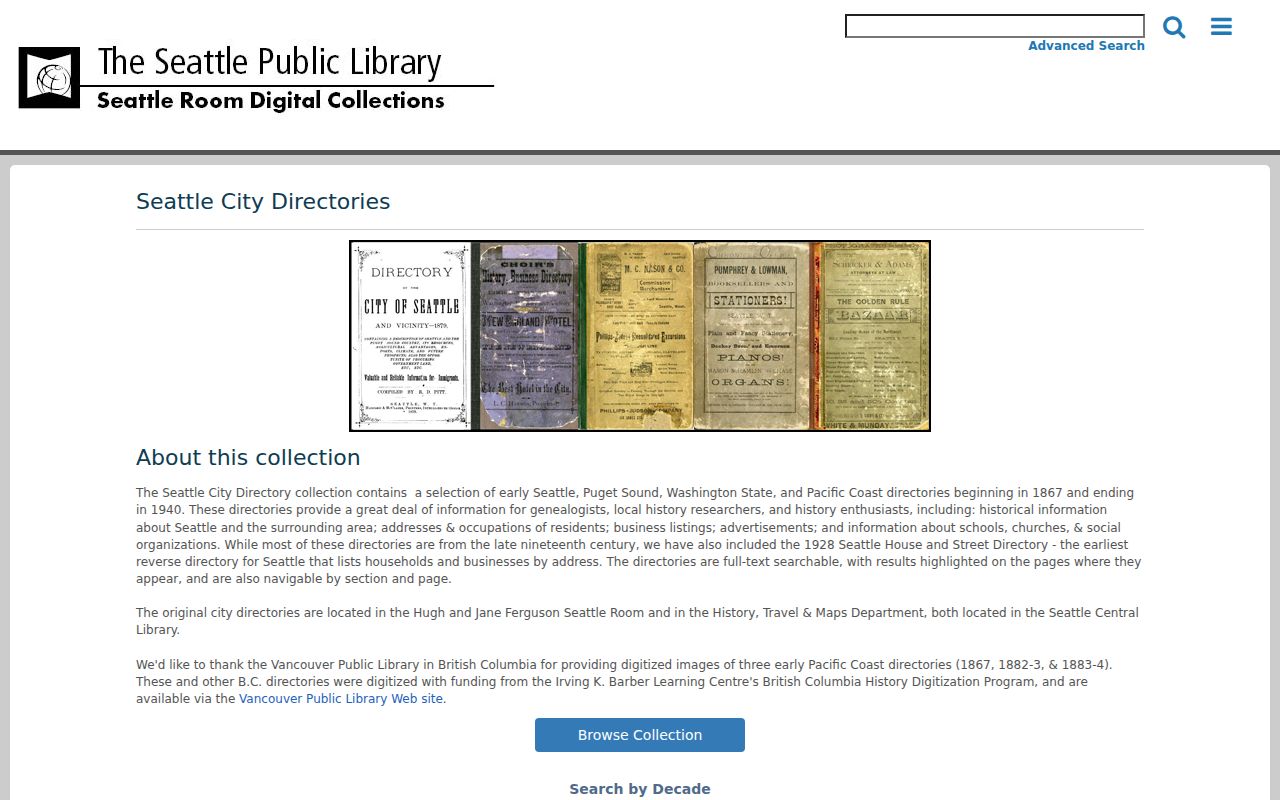
The capture helps distinguish a searchable scan from a complete name database. Always open the scanned page and save its edition and page, since the highlighted text alone may omit context.
Some related databases require a library card or in-library access. Licensing also changes. Note whether the directory, newspaper, census, or map was open online, card-only, or available only at Central Library when the search was made.
Note: A blank full-text result does not prove that a name is absent from the printed Seattle volume.
Seattle Room Directory Research
The Central Library separates genealogy from Seattle local history. Level 9 holds more than 40,000 genealogy volumes, periodicals, pamphlets, and microfilm. The collection began in 1926 with material from the Seattle Genealogical Society. A genealogy librarian offers a free 30-minute appointment in person, by phone, or online. In the catalog, the location limit REF - Level 9 - Genealogy helps isolate those holdings.
Level 10's Seattle Room is noncirculating and includes Seattle city directory volumes, maps, newspapers, yearbooks, photographs, oral histories, and neighborhood records. Research appointments are commonly offered Tuesday through Thursday from 1 to 5, in windows from 30 minutes to two hours, but current availability should be confirmed. Use REF - Seattle Room in the catalog and tell staff the name, street, year range, and directory title already checked.
Research tip. Ask for the physical edition when a scan is missing or unreadable, and bring a list of spelling and street-name variants.
Decode a Seattle Directory Entry
A directory line is a dated claim printed for one edition. It may name a person, address, occupation, firm, school, church, or social organization. It can also describe a boarder, business occupant, or absent owner. Do not turn that line into proof that the person stayed there all year. Copy the line exactly before interpreting abbreviations, and keep the edition and page attached to every note.
| Name | The indexed spelling or initials; compare nearby names and variants. |
|---|---|
| Address | The house number, street, room, or business location exactly as printed. |
| Work or group | An occupation, business, school, church, club, or other dated link. |
| Edition and page | The source coordinates needed to find and cite the scan again. |
| Cross-check | A reverse-directory entry, later edition, newspaper, map, or official index. |
The research did not open a named personal entry, so no fictional example belongs here. A safe inventory reads: directory title, edition year, name as printed, address, business or occupation if printed, page, access method, and the next source used to verify it.
- Criss-cross directory
- A directory arranged by street or address, rather than only by a person's surname.
- Householder index
- An address-order list used to connect a building with the named householder in that edition.
- Abbreviation key
- The volume's own list of shortened words and marks. Read it before assigning meaning to a symbol.
Seattle's 1928 Reverse Directory
The 1928 Seattle House and Street Directory is the earliest reverse directory identified in the SPL collection. Instead of starting only with a surname, a researcher can begin with a house number and street. That makes the volume especially useful when a photograph, deed, letter, or family note supplies an old address but no clear resident name.
Street names and numbers must match the period. Search an address in the reverse volume, copy each person or business shown, and then find those names in the ordinary alphabetical edition. A dense apartment or commercial address may list several people or firms. Preserve units or room numbers as printed. For later or current address-based work, use the Seattle Street Directory rather than treating this historical snapshot as current.
Can a reverse result prove occupancy? No. It is strong evidence that a name or business appeared at the address in that edition, but a second dated source should confirm the role.
Trace Families in Seattle Directories
Seattle city directories can bridge the years between federal census schedules. Begin near a firm date, then move backward and forward one edition at a time. The HeritageQuest collection includes census material through 1940, while library newspaper databases can supply obituaries, notices, and community links. Access may depend on a library card or an in-library visit.
- Find the alphabetical entry nearest the known year. Copy its exact spelling, address, business or group, page, and edition.
- Check the 1928 reverse directory when the date fits, or another street-order source, to see how that address is listed.
- Repeat the name search in an edition before and after. Record changes instead of assuming every similar name is the same person.
- Pair directory years with census records, newspapers, and Washington Digital Archives life-event indexes.
- End with a dated conclusion, such as "listed in the 1928 edition," never a claim of present residence.
A disappearance has several possible causes. The person may have moved, died, changed a surname, become unlisted, or fallen into a missing edition or search error. An obituary, later directory, marriage record, cemetery index, or census can separate those paths. The modern Seattle resident lookup describes how to test a historic find against other official records without merging people who share a name.
Seattle Directories Before Annexation
Seattle's city limits grew through a major annexation wave. South Seattle joined in 1905. Southeast Seattle, Ravenna, Columbia, South Park, Ballard, and West Seattle followed in 1907, and Georgetown joined in 1910. An older address may therefore appear under a predecessor municipality, even when the same place is called Seattle now. The City Archives annexed-cities reference connects dates, ordinances, and a map.
The street system changed too. Later civic work reshaped shorelines and hills, and a 1961 directional system affected address retrieval. A north-end entry may need an old prefix; a West Seattle address may need a former jurisdiction; a waterfront site may have changed through grading or redevelopment. Check street-designation maps and annexation files before concluding that an address vanished.
| Year | Seattle directory research milestone |
|---|---|
| 1867 | Beginning of the selected online directory range described by SPL. |
| 1890 | Beginning of the directory range described by Seattle City Archives. |
| 1905-1910 | Annexations move several predecessor communities into Seattle records. |
| 1928 | Earliest reverse House and Street Directory identified in the SPL collection. |
| 1961 | Directional street-system change adds an address crosswalk issue. |
| 1990 | End of the City Archives described directory range. |
Confirm Seattle Directory Clues
One entry becomes more useful when paired with a source that answers a different question. SPL describes Seattle Times coverage from 1895 to the present and Seattle Post-Intelligencer coverage from 1901 to the present, with access terms that may vary. Its Sanborn map collection spans 1867 through 1970 and shows building footprint and use, not a resident roster. Yearbooks can connect a name to a school, while church and organization listings can place a person in a dated community.
The Washington Digital Archives holds collection-specific death, marriage, cemetery, and other indexes and images. King County death records cover 1891-1907, Seattle municipal death material covers 1881-1907, and King County marriage records span 1855-2017 in the described collection. Search fields differ by collection, and an index is not always the source image.
City Archives adds tax lists, court dockets, petitions, correspondence, and the Denny Park Cemetery Removal and Reburial Register. Those records establish distinct roles: taxpayer, court party, petitioner, or buried person. None should silently become "resident." Keep the role, source date, series title, and any access limit in the final note.
Note: A Seattle city directory appearance is strongest when another dated record agrees on name, place, family, or organization.